I joined as the first product manager alongside two founders, built the product function and took the platform to product-market fit.
The starting point · an equipment-maker's view, elevator-company customers
Arquos was born inside Kanopée, a startup studio focused on construction tech. The founders came from the equipment world and thought like suppliers, while the real customers are elevator maintenance companies. Requirements lived in conversations, expressed as they came, with no backlog and no personas.
What I rebuilt · real discovery, a product foundation
User interviews across every persona, personas built, problems framed, a structured backlog. I put method back where everything was going in all directions.
The turning point · the real problem was not the one we assumed
An elevator changes over time: its parts are replaced during works, often with non-original components. Elevator companies do not know what their fleet is made of, or do not trust their own data. The interviews also showed that data entry had to be fast and unguided, never a form.
The product · photos in bulk, an equipment database, documents
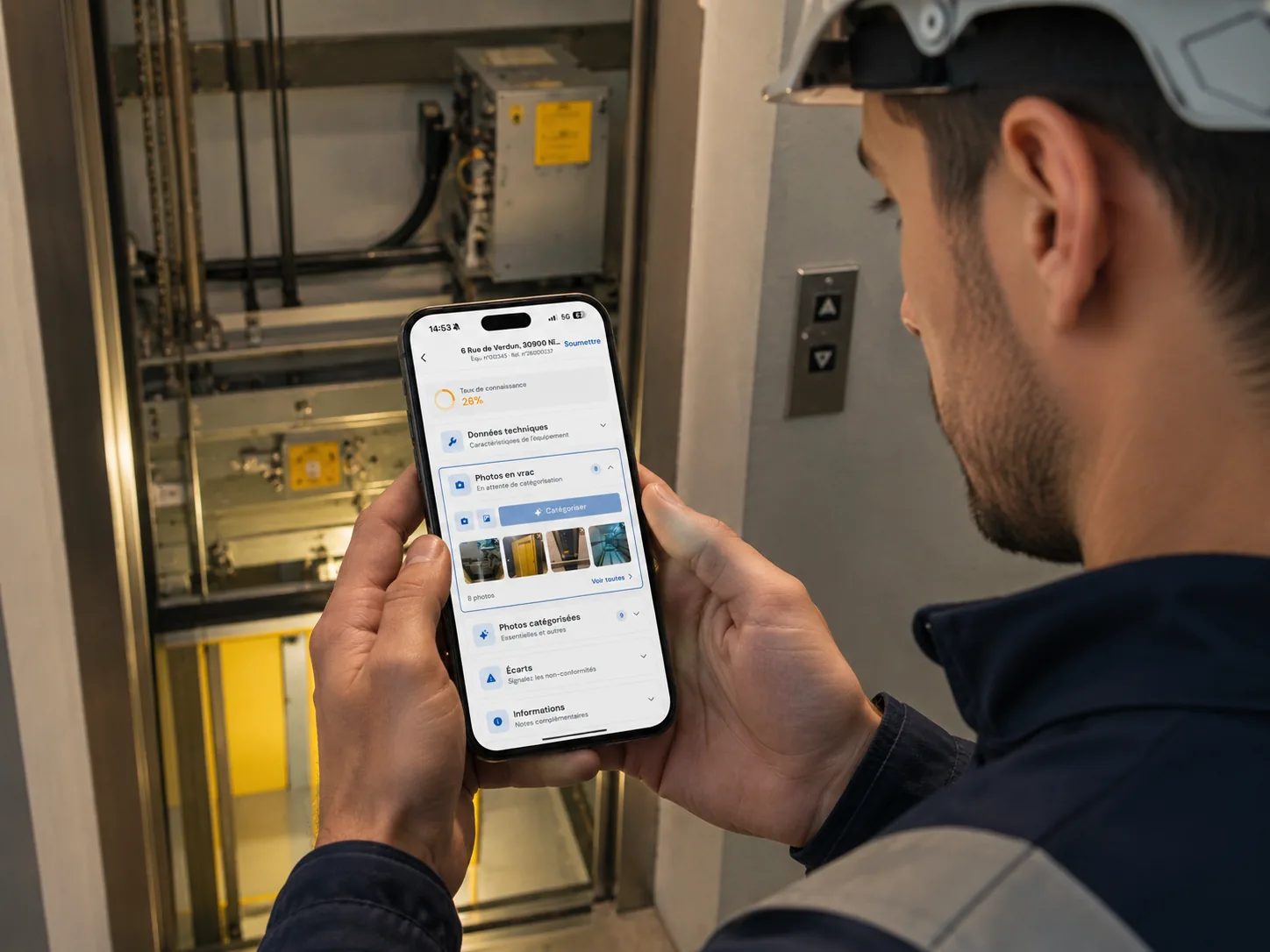
A mobile app where the technician takes photos in bulk, in a few seconds, during the visit. Vision and OCR AI classifies them and extracts more than a thousand technical fields, so the customer builds the database of their own fleet. That database then produces the work quotes, maintenance contracts, condition reports and safety studies sent to their clients, the supplier requests to source the right part, and the 3D drawings.
The supplier request flow
To ship faster, we had reused the customer-facing view for suppliers: same components, an "existing" section and a "needed" section. It did not suit suppliers at all, and some refused to quote when they received a request.
The point that decided the trade-off: the supplier does not pay, but their refusal blocks usage for the customer who does. A user outside the business model could make the feature fail for those inside it.
I ran about ten supplier interviews to understand what was not working, then had the view entirely rebuilt, with logic of its own instead of mirroring the customer view.
Today
I lead both applications, web and mobile, with three engineers, and I run Arquos Studio, our custom development offer.